
Generative AI Explained: What It Is, How It Works, and Why It Matters to You
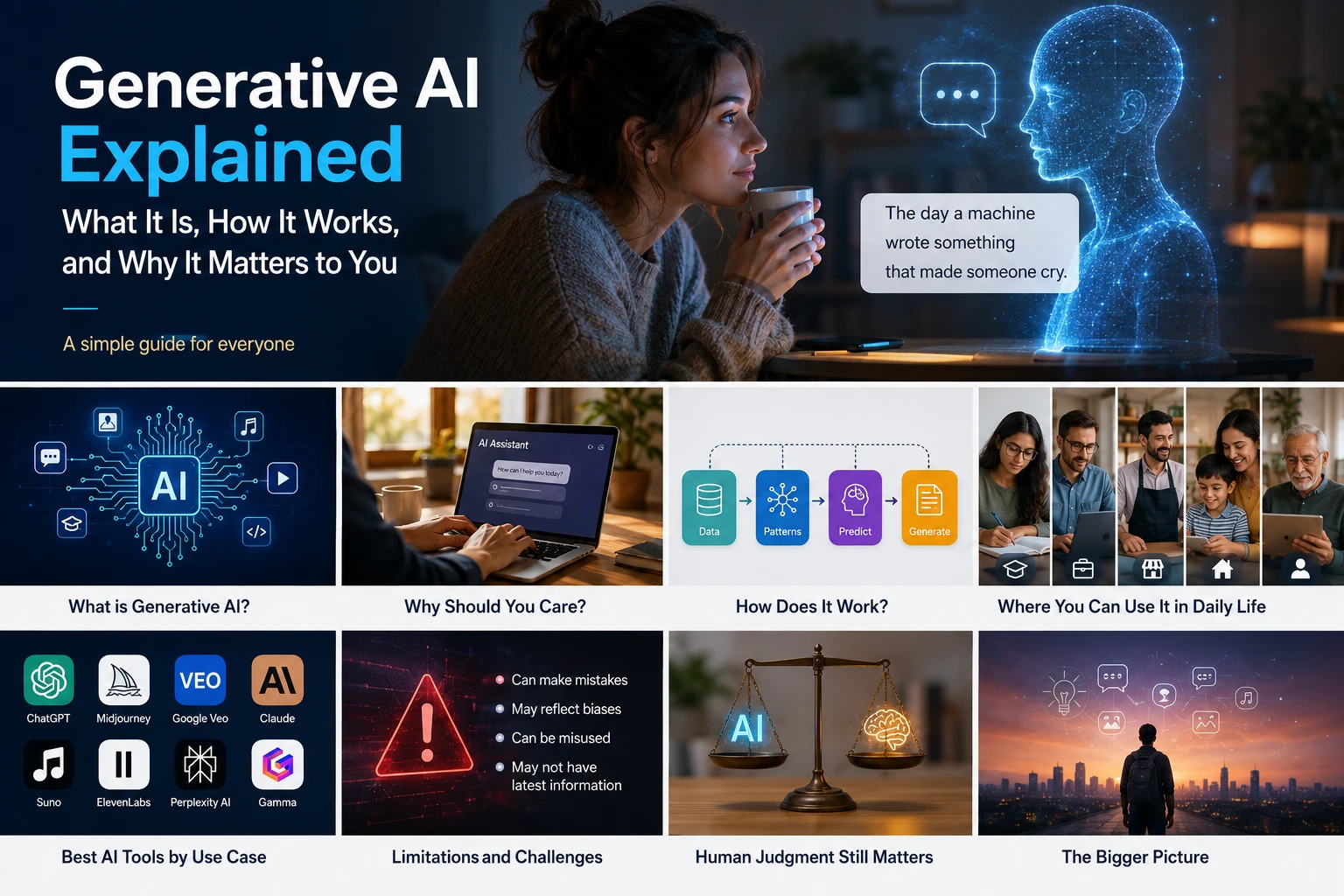
The Day a Machine Wrote Something That Made Someone Cry
In 2022, a woman named Eugenia Kuyda lost her best friend, Roman Mazurenko, in a tragic accident. Heartbroken and desperate to hold on to his memory, she fed thousands of his old text messages into an AI system and created a chatbot that could respond the way Roman used to.
Friends began texting the chatbot, and its replies felt so much like Roman that some of them were moved to tears.
You can debate whether that’s beautiful or unsettling. But one thing is hard to ignore: a machine generated responses that felt so human that people formed an emotional connection with it.
That’s the quiet power of generative AI
Today, millions of people use Generative AI without even realizing it. From writing assistants and AI powered chatbots to image generators and personalized recommendations, this technology is quietly becoming part of our daily lives.
What Is Generative AI?
Generative AI is a type of artificial intelligence that can create new content such as text, images, music, videos, or computer code from scratch, based on simple instructions called prompts.
A prompt can be a question, an idea, or even a single sentence. In simple terms, you tell the AI what you want, and it creates something new in response.
Unlike a search engine that simply finds existing information, Generative AI generates original content, much like a person would
Why Should Everyday People Care About Generative AI?
For decades, getting a computer to do something complex usually meant learning programming or specialized software. In other words, people had to adapt to machines. Now, things have changed. The machine has adapted to us. If you can type a normal sentence, you can ask AI to explain a difficult concept, draft an email, summarize a document, or brainstorm ideas.
Imagine you’re a student struggling with a difficult math problem at 2:00 AM. Instead of waiting until the next day, you can ask an AI assistant to explain it step by step in simple language.
That’s why Generative AI matters. It helps people solve everyday problems faster and saves something we can never get back: time. Just as smartphones changed how we access information, Generative AI is changing how we interact with information itself.
How Generative AI Makes Everyday Life Easier
Some of the biggest benefits of Generative AI include:
1. Faster content creation
- Drafting emails or reports in minutes.
- Creating social media captions for different platforms.
- Generating blog outlines or marketing copy.
2. Improved productivity
- Summarizing lengthy documents into key points.
- Organizing meeting notes into action items.
- Helping write or debug code more quickly.
3. Better access to knowledge
- Explaining complex topics in simple language.
- Answering questions about science, history, or mathematics.
- Translating content between languages.
4. Assistance with repetitive tasks
- Categorizing customer support requests.
- Drafting responses to frequently asked questions.
- Cleaning and formatting repetitive data.
5. Enhanced creativity
- Brainstorming story ideas.
- Suggesting marketing campaign concepts.
- Creating recipes using available ingredients.
6. Personalized learning experiences
- Explaining concepts in different ways until they make sense.
- Generating practice questions based on your skill level.
- Creating customized study plan
Even if you never become an AI expert, understanding Generative AI will help you navigate a world where these tools are becoming increasingly common.
How Does Generative AI Actually Work?
Think about how you learned to bake.
You weren’t born knowing how to make chocolate chip cookies. You watched your parents, followed recipes, tasted different versions, and learned what worked and what didn’t. Over time, your brain recognized patterns. You learned what makes a cookie taste good. Now, when someone asks you to bake cookies, you don’t memorize one recipe word for word. Instead, you use everything you’ve learned to create a fresh batch.
Generative AI learns in a surprisingly similar way.
Step 1: Learning from huge amounts of data
Developers train AI using enormous collections of text, images, audio, videos, and other data. This can include billions of books, articles, websites, conversations, and more.
Step 2: Recognizing patterns
Instead of memorizing everything, the AI learns patterns.
It notices how words fit together, how sentences are structured, and how ideas naturally connec, what makes a sentence feel complete.
Step 3: Learning what comes next
After training, the AI becomes very good at predicting what should come next.
When you ask a question, it predicts the sequence of words most likely to produce a helpful and natural response.
Step 4: Generating new content
When you enter a prompt, the AI doesn’t simply copy information from the internet. It treats your prompt as a starting point and uses its learned patterns to predict, word by word or pixel by pixel, what should come next to fulfill your request perfectly.
You can think of it as an incredibly advanced, highly sophisticated version of the predictive text on your smartphone’s keyboard, guessing the most logical next piece of the puzzle based on everything it has ever learned.
Where Can You Use Generative AI in Everyday Life?
The most exciting part isn’t the technology itself. It’s what people can do with it.
For Students:
- Understand difficult concepts
- Create study guides
- Summarize lengthy articles
- Generate practice questions
- Improve writing skills
It’s like having a study partner available whenever you need one.
For Working Professionals:
- Drafting emails
- Creating presentations
- Writing reports
- Brainstorming ideas
- Summarizing meetings
Tasks that once took hours can often be finished much faster.
For Small Business Owners:
- Create marketing content
- Write social media posts
- Generate product descriptions
- Draft customer support responses
This allows them to focus more on growing their business instead of getting stuck on repetitive task.
For Homemakers:
- Meal planning
- Budget management
- Travel planning
- Creating shopping lists
- Finding educational activities for children
Sometimes, even small conveniences can make everyday life much easier.
For Retirees:
- Learn new hobbies
- Research travel destinations
- Organize family history projects
- Improve digital skills
- Explore personal interests
Based on my experience i have listed the Best all-around tools by use case
Best Generative AI Tools by Use Case
| Use Case | Recommended Tool |
|---|---|
| Writing & learning | ChatGPT |
| Image generation | Midjourney |
| Video generation | Google Veo |
| Coding | Claude |
| Music creation | Suno |
| Voice generation | ElevenLabs |
| Research | Perplexity AI |
| Presentations | Gamma |
What Are the Limitations and Challenges of Generative AI?
Generative AI is impressive, but it isn’t perfect.
Like any technology, it has limitations.
1. It can make mistakes:
AI doesn’t truly understand information the way humans do. Sometimes it confidently generates incorrect answers, a problem often called AI hallucination.
2. It Can Reflect Human Bias:
Because AI learns from human-created data, it can sometimes reproduce the biases present in that data.
3. It can be misused:
Generative AI can be used to create deepfakes, spread misinformation, or help with academic dishonesty.
Like many powerful technologies, how it’s used depends on the person using it.
4. It Doesn’t Always Know the Latest Information
Many AI models are trained on data collected up to a certain point in time. Unless they have access to live information, they may not be aware of recent events or developments.
Human Judgment Still Matters
Generative AI is a powerful assistant, but it shouldn’t replace human thinking.
Use it to brainstorm ideas, speed up repetitive work, and explore new possibilities—but always verify important information and apply your own judgment.
The Bigger Picture Behind Generative AI
Generative AI won’t solve every problem, and it won’t replace human creativity, empathy, or judgement in any meaningful way. What it does do is give ordinary people powerful new ways to learn, create, and solve problems without needing a technical background.
The woman who built a chatbot to hold onto her friend’s memory wasn’t a programmer. She simply found an unexpected use for a remarkable technology during one of life’s most difficult moments.
In many ways, that captures what Generative AI is really about.
It’s just a tool. What makes it meaningful is the human intention behind it.
Final Thoughts:
Generative AI is still evolving, and like every major technology before it, the way we use it will shape its impact. The more we understand it, the better we can use it responsibly and creatively.
What would you create with Generative AI, if you gave it a chance?