
What Are AI Agents? A Beginner’s Guide to the Smart AI Assistants Changing Everyday Life
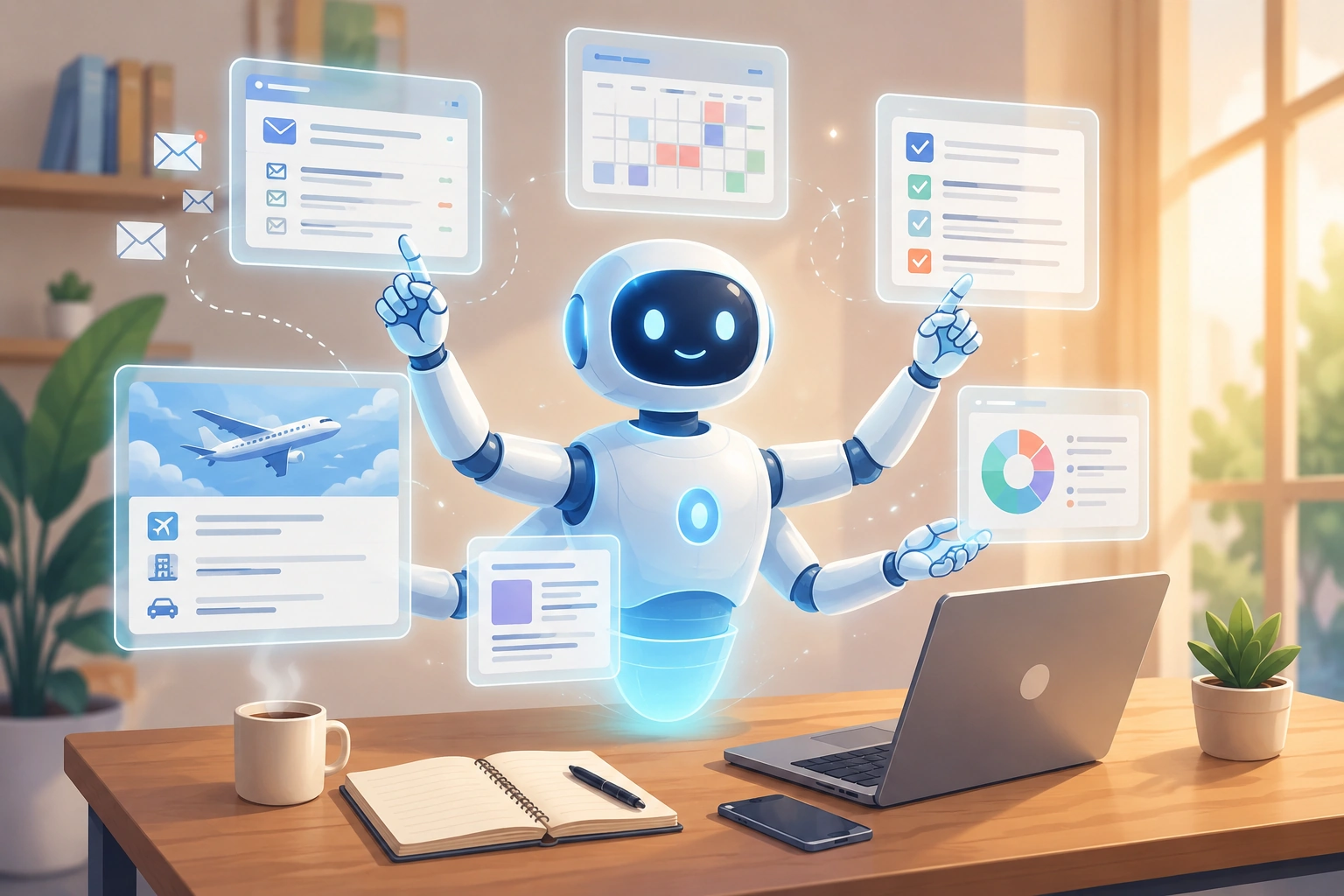
Have You Ever Wished Your Computer Would Just Get Things Done?
A few months ago, I was helping a friend plan a family vacation. What seemed like a simple task quickly turned into hours of searching for flights, comparing hotels, checking the weather, finding places to visit, and trying to stay within a reasonable budget. We joked that what we really needed was a personal assistant, someone who understood what we wanted and could take care of all the tedious work.
What if software could do exactly that? That’s exactly where AI Agents come in.
Today, AI Agents are helping businesses automate repetitive work, assisting developers with coding, supporting customer service teams, organizing schedules, researching information, and even making everyday life a little easier.
What Are AI Agents?
AI Agents are intelligent software programs that can understand a goal, create a plan, and take the necessary steps to complete it with little or no human guidance. As they work, they can adapt to new information or changing situations to achieve the best possible result.
Here’s a simple way to think about it.
Imagine you’ve hired a personal assistant:
You don’t explain every tiny step involved in a task. Instead, you simply say:
“Please organize my business trip to Bengaluru next week.”
Your assistant figures out what needs to happen next. They book flights, compare hotel prices, check meeting schedules, arrange transportation, and even let you know if something changes along the way. You gave them a goal, not a step-by-step instruction manual.
An AI Agent works in much the same way.
What Makes AI Agents Different from Traditional AI?
Rather than waiting for instructions after every step, it figures out what needs to be done, takes action, and adjusts its approach if circumstances change.
That’s what makes AI Agents different from traditional AI tools, which usually respond to one prompt at a time instead of working toward a larger goal.
Why Should You Care About This Tech Evolution?
AI Agents are changing the way we interact with technology.
Instead of manually clicking through different apps and websites to complete a task, you simply describe what you want to achieve. The AI Agent then plans the work, gathers the information it needs, uses the right tools, and works toward completing your goal.
Think about how many repetitive digital tasks fill your day:
- Searching through emails
- Comparing products before buying
- Filling out forms
- Scheduling meetings
- Organizing files
- Researching information
- Writing reports
- Following up on reminders
Now imagine handing many of those tasks over to an intelligent assistant. That’s where AI Agents can make a real difference.
By taking care of repetitive and time-consuming work, they free up your time so you can focus on the things that matter most—whether that’s solving bigger problems, being more creative, or simply getting more done in less time.
How Do AI Agents Actually Work?
Think of the entire process like using a GPS navigation app.
- You tell it where you want to go.
- It finds the best route.
- If there’s traffic ahead, it recalculates.
- If you miss a turn, it automatically adjusts and gets you back on track.
- You stay focused on reaching your destination while the GPS handles the route.
AI Agents work a very similar way. So, what actually happens after you give an AI Agent a goal?
Let’s walk through the process step by step.
Step 1: Understanding the Goal
Everything starts with a goal. Rather than waiting for a list of detailed instructions, the AI Agent first tries to understand what you’re actually trying to accomplish.
For example:
“Find the best laptop for video editing under ₹80,000 and compare the top three options.”
Instead of immediately producing an answer, the AI Agent first understands what success looks like. In this case, it needs to find suitable laptops, compare them, and recommend the best choices within your budget.
A clear goal gives the AI Agent a clear direction.
Step 2: Creating a Plan
Once it understands the goal, the AI Agent creates a plan. Instead of trying to solve everything at once, it breaks the task into smaller, manageable steps.
For the laptop example, it might decide to:
- Search for laptops that fit your budget
- Compare their specifications
- Read customer reviews
- Check the latest prices
- Organize everything into an easy-to-read comparison
Just like a person tackling a large project, the AI Agent works through each step in a logical order before moving to the next.
Step 3: Using the Right Tools
An AI Agent can often interact with external tools or software, depending on how it has been designed. Instead of relying only on its built-in knowledge, it can gather fresh information when needed.
For example, it may:
- Search the web
- Read documents
- Access databases
- Use calendars
- Send emails
- Work with spreadsheets
- Connect to business software through APIs
Because of this, AI Agents can work with up-to-date information instead of relying only on what they already know.
Step 4: Evaluating Progress
A good assistant doesn’t stick to the original plan when something change and neither does an AI Agent. As it works, it continuously checks whether it’s still moving toward the goal.
For example:
- A website might become unavailable.
- A meeting could be cancelled.
- A better product might become available.
- New information could change the best course of action.
Instead of stopping, the AI Agent adjusts its plan and continues working. This ability to adapt is one of the biggest reasons AI Agents can handle more complex tasks than traditional AI systems.
Step 5: Completing the Task
Finally, the AI Agent presents the result or performs the requested action. Depending on the task, it may also ask for your approval before taking important actions, especially if money, sensitive information, or permanent changes are involved.
In most real-world situations, AI Agents are designed to work alongside people rather than replace them.
Where Can AI Agents Make Everyday Life Easier?
AI Agents aren’t just for tech companies or software developers anymore. They’re becoming useful tools for people from all walks of life. Whether you’re a student, a working professional, a business owner, or simply looking to make everyday tasks easier, AI Agents can help save time and reduce repetitive work.
Here are a few real-world examples.
For Students
AI Agents can act like a personal study partner by helping you:
- Research a topic and summarize information from multiple sources
- Create essay outlines or first drafts based on your ideas
- Generate practice questions to help you prepare for exams
- Keep track of assignment deadlines and send reminders
- Explain difficult concepts in simpler terms and suggest additional learning resources
Instead of spending hours switching between tabs, students can focus more on learning.
For Working Professionals
Many office tasks are repetitive, making them perfect candidates for AI assistance.
AI Agents can help you:
- Compare reports and organize data into clear tables
- Draft emails, meeting agendas, or status updates
- Research competitors and summarize key findings
- Prepare background information before important meetings
- Handle routine administrative work like formatting documents or filling out standard forms
This leaves you with more time to focus on strategic and creative work.
For Small Business Owners
Running a business often means wearing multiple hats. AI Agents can help lighten the workload by:
- Monitoring customer reviews and suggesting replies
- Updating product descriptions and online listings
- Sending follow-up messages to potential customers
- Comparing suppliers, prices, or service providers
- Drafting social media posts based on your latest updates
Instead of juggling dozens of small tasks, business owners can spend more time growing their business.
For Homemakers
AI Agents can also make everyday home management much easier.
They can help you:
- Plan weekly meals and create grocery lists
- Compare prices before buying household items
- Summarize long articles, school notices, or important documents
- Keep track of birthdays, appointments, and school events
- Suggest recipes based on the ingredients already available at home
Small tasks become quicker, giving you more time for the things that matter most.
For Retirees
AI Agents can make technology feel less overwhelming and more helpful in everyday life.
They can:
- Research travel destinations and build simple itineraries
- Help write letters, applications, or complaints
- Summarize lengthy news articles or government documents
- Set reminders for medications, appointments, or bill payments
- Answer questions patiently whenever you need help
It’s like having a helpful digital assistant that’s available whenever you need it.
Best 10 AI Agents in Action (2026)
| Rank | AI Agent | Best Categories | Ideal Use Cases |
|---|---|---|---|
| 1 | ChatGPT Agent | General AI Assistant, Research, Writing, Coding, Data Analysis, Productivity | Answering questions, writing content, programming, analyzing files, brainstorming, task automation |
| 2 | Claude | Writing, Research, Business Analysis, Document Processing | Long-form writing, summarizing lengthy documents, strategic planning, reasoning |
| 3 | Gemini | Productivity, Research, Google Workspace, Multimodal Tasks | Gmail, Docs, Sheets, Drive, web research, image understanding |
| 4 | Devin | Software Development | End-to-end software engineering, coding, debugging, testing, deployment |
| 5 | OpenAI Codex | Coding & Development Automation | Writing code, fixing bugs, code reviews, generating pull requests |
| 6 | Perplexity AI | Research & Information Gathering | Finding accurate answers, web research, citations, market research |
| 7 | Manus AI | Autonomous Task Execution, Content Creation, Research | Creating reports, presentations, websites, spreadsheets, and completing multi-step tasks |
| 8 | Salesforce Agentforce | Customer Support, Sales, CRM | Customer service, lead qualification, sales automation, CRM workflows |
| 9 | Microsoft 365 Copilot | Office Productivity, Business, Data Analysis | Word, Excel, PowerPoint, Outlook, Teams, meeting summaries, business reports |
| 10 | Lindy AI | Personal Productivity, Workflow Automation | Scheduling meetings, email automation, reminders, personal assistant tasks |
Which AI Agent Should You Choose?
This list reflects some of the most capable AI Agents available today. The right one depends on what you’re trying to accomplish. Some excel at coding, while others are better suited for writing, research, productivity, or business automation. As AI technology continues to evolve, we’ll likely see even more specialized AI Agents designed for different industries and everyday tasks.
Limitations of AI Agents:
1. What AI Agents Still Can’t Do Well
Like any technology, AI Agents aren’t perfect. They can misunderstand instructions, make incorrect assumptions, or confidently provide inaccurate information. Their performance also depends heavily on the quality of the data and tools they can access.
2. Privacy and Security Considerations
Privacy and security are equally important considerations, especially when an AI Agent is connected to emails, calendars, financial accounts, or business systems.
3. Should You Trust AI Agents Completely?
That’s why it’s important to review important decisions instead of relying on AI without oversight.
For now, it’s best to think of AI Agents as capable assistants that work alongside people—not as independent decision-makers.
Final Thoughts:
AI Agents are changing the way we interact with technology. Instead of simply answering questions, they’re becoming capable assistants that can plan, take action, and help us complete real-world tasks more efficiently.
They won’t replace human judgment anytime soon—and they aren’t meant to. Their greatest value lies in handling repetitive work, giving us more time to focus on creativity, problem-solving, and the decisions that truly need a human touch.
As the technology continues to improve, AI Agents will likely become as common as search engines and smartphones are today.